FROM SURVIVING
TO GUIDING
KATE HINTON
USES HER LIVED EXPERIENCE TO NOW HELP OTHERS
January 15, 2026
THE VIEW FROM THE OTHER SIDE
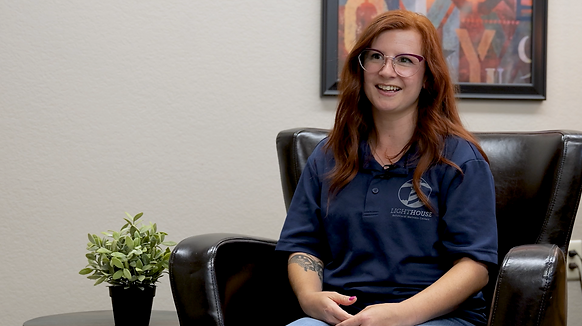
The first thing noticeable about Kate Hinton isn’t her fiery, red hair. It’s her warmth. There’s an approachable presence about Hinton. A tell-me-whatever-you-need-to-say-because-I’m-listening spirit. It’s what makes her so good at being a Peer Recovery Support Specialist (PRSS) at the Lighthouse CSU in Ardmore.
“You never know what you’re walking into in the CSU,” says Hinton, who could be working with clients dealing with suicide ideation or battling addiction or any number of mental illnesses. “Every morning, I go around and check in with everyone and see how they’re doing. I introduce myself and see what they need or if they are still battling with certain thoughts. I get a game plan for each client, what specifically they need while they’re here.”
She understands their fears and anxiety on a personal level because she’s been there too: placed in-patient, battling suicidal thoughts, and living a life overwhelmed by chaos.
For Hinton, who didn’t initially get the help she now provides others, those suicidal thoughts turned into a suicide attempt at age 19. She’d left home three years earlier, escaping a stepfather with a substance abuse problem and a mother with mental health issues. Without direction or stability, her life had turned into evenings partying and days nursing a hangover. All of it leading to an overdose of clonazepam.
“I don’t feel like I got the kind of care I wish I had gotten. They didn’t have a PRSS like me. It was just a couple of techs to make sure you’re okay in a day room. That was about it,” Hinton remembers. “I met with a counselor one time and, after three days of being there, he said, ‘Well, why did you try to kill yourself? And I said, ‘Because I hate my life. I don’t want to be here.’ And he said, ‘I don’t believe you. I think you just did it for attention.’ Then he discharged me.”
After that, Hinton turned away from seeking professional help and turned to self-medicating. Over the course of the next four years, she would experience drug abuse, homelessness, criminal charges, and being trapped in a physically abusive relationship that seemed impossible to escape.
“I tried getting away from my boyfriend several times,” says Hinton, who found herself covering her bruises and making excuses when his abuse sent her to the hospital. “When they say that it takes seven tries to leave an abusive relationship, it really does take multiple tries. It’s not as easy as people think. It’s not as easy as just packing your bags and leaving. What most people don’t understand is that there’s a manipulative person who’s trying to harm you and they will do anything to try and get to you. He threatened my friends, took my dog. I think it took me five tries to reach the final time.”
To escape, it meant finally asking for help, which required her admitting to herself and to her friends the reality of her relationship.
“I was afraid to tell anyone because it felt embarrassing. I felt ashamed to have this guy have so much control over me and be beating me,” she says.
Finally, she admitted to friends and, with their help, went into hiding, changing her phone number, email address, social media accounts, and staying off the grid while he went to multiple states searching for her.
“It was quite the roller coaster,” says Hinton.
She suffered panic attacks, anxiety, and PTSD from years of being traumatized. All of it she can see now but couldn’t see then, like many of her clients. She needed stability, but she continued looking for it in the wrong place. And, once again, she found herself in a toxic relationship.
“I thought he was Prince Charming. He had a house, a nice sports car. I fell for all his love bombing. We were dating a week when he gave me a beautiful necklace. We were dating two weeks when he took me on a vacation. And I fell for all of it.”
Things, however, were about to take a sudden shift when she got the news she was expecting. Even in all her chaos and trauma, Hinton had dreamed of having a daughter, even picking out her name before she’d ever conceived. Now, that dream was reality. And that little baby, before even being born, changed everything.
“When I got pregnant, I realized everything I did affected my child. I got sober and stopped using. That’s when I started realizing my triggers and how I was coping with everything for so long. Once I got my wish (for a child), I knew that all she had was me and she depended on me. I needed to do what was right for her.”
As she made healthy choices, her (now-ex) husband made poorer ones, declaring his refusal to change. Drugs, partying, that was the life he wanted. She didn’t stop him, choosing, instead, to simply not participate. However, that wasn’t going to create a healthy environment for her daughter. And, one day, she realized she had to break the cycle.
“There was this moment when we were fighting, and my daughter walked into the kitchen screaming. Just like that, the lightbulb goes off. I realize this is not how it’s supposed to be. I was setting the example for her, and she would think this is how a couple talks to each other. It clicked and I said, ‘I cannot do this anymore.’ My daughter deserved so much more than that.”
WHEN LIFE TRULY CHANGED
Life is completely different now. Once Hinton got on medication and started outpatient therapy, she learned how to address her trauma and triggers. She learned how to practice EMDR (Eye Movement Desensitization and Reprocessing) therapy and, as she explains it, “dove into my traumas.”
Eventually, she moved to Oklahoma and, as time and therapy brought healing, started reconnecting with her family.
“I started repairing the relationship with my dad and that side of the family. Then, a few years later, I repaired the relationship with my mom. I never thought I’d be in a place where I have healthy, loving relationships with my parents, but I do and it’s great,” says Hinton.
She began to plan for a new life.
“I asked myself, ‘What is really important to me? What resonates with my long-term happiness?’ And I wanted to become a counselor. I wanted to help others, like that therapist who was there for me when I started to heal, recover, and find myself again.”
Hinton enrolled in Murray State College, receiving her associate’s degree in the spring of 2025. She is now enrolled in Oklahoma State University working towards her bachelor’s in psychology. She is becoming a counselor that can be there for others, while serving as a trained Peer Recovery Support Specialist for Lighthouse.
“I get what they’re feeling,” says Hinton about her clients in the CSU. “I see life from their perspective because I’ve lived it, so I can understand what they might need in that moment, whether it’s just silence and comfort or reassuring words.”
Once they get to a point where they’re ready to take the next step in their healing, Hinton says it also places her in a position to get them connected to the resources they need, the resources she wishes she’d had when in that situation.
AN EXAMPLE TO LIVE BY
“What Hinton does as a PRSS is the backbone of what we do,” says Rick Finley, Director of Crisis Stabilization at Lighthouse. “The PRSS can do things that others, like myself, can’t. They’ve been in their shoes. They can meet the client where they are, and that’s huge".
These team members have their own recovery stories. They’ve been where the client is at that moment—afraid, angry, confused, panicked, lost. It gives them unique insight you can’t learn in a book, says Finley. It helps them know what questions will be asked and what answers that client needs to hear.
“All our of our PRSS team members have a different story of recovery,” says Finley. “Some dealt with substances, some alcohol, some abuse. They’ve been in the client’s situation, dealt with that issue, and done well with their life. They are someone with wisdom that can meet clients where they’re at and understand what they’re going through.”
Not only do they provide that relational connection for clients; they also provide boots-on-the-ground information and insight because they understand the client’s environment. That was their old stomping grounds, and they knew, should the client return, it could undermine their recovery efforts.
“Those are things I wouldn’t even think about,” says Finley, who said those who serve as a PRSS at Lighthouse have also helped find clients the best rehab facilities because they have been patients themselves.
What is being on the other side of therapy like for the PRSS? Can they see themselves in their clients?
Hinton says absolutely.
“Yeah, a lot, especially when we get young girls in who just had a suicide attempt. I see the younger me and I just try to let them know that I once was in your shoes and you’re not alone. And I understand that this can be scary, but I’m here for you. Or,” says Hinton, “the mom who’s coming out of a domestic violence situation or getting someone out of a toxic relationship or an unsafe environment. Helping them? That really fills my cup.”
It’s experiences like Hinton’s that have helped clients who now find themselves on the road to recovery, working stable jobs, and rebuilding relationships. Now, the future has hope, and every win is a celebration.